

You know this feeling.
Your company announces real news. A new contract. A strategic partnership. A revenue milestone. Something that genuinely matters.
And then, almost nothing happens.
No sustained discussion. No spike in investor awareness. No liquidity impact worth mentioning.
The instinct is to question the news itself. Was it not compelling enough? Did we frame it wrong? Did we pick the wrong day?
Usually, that is not the problem.
The problem is visibility.
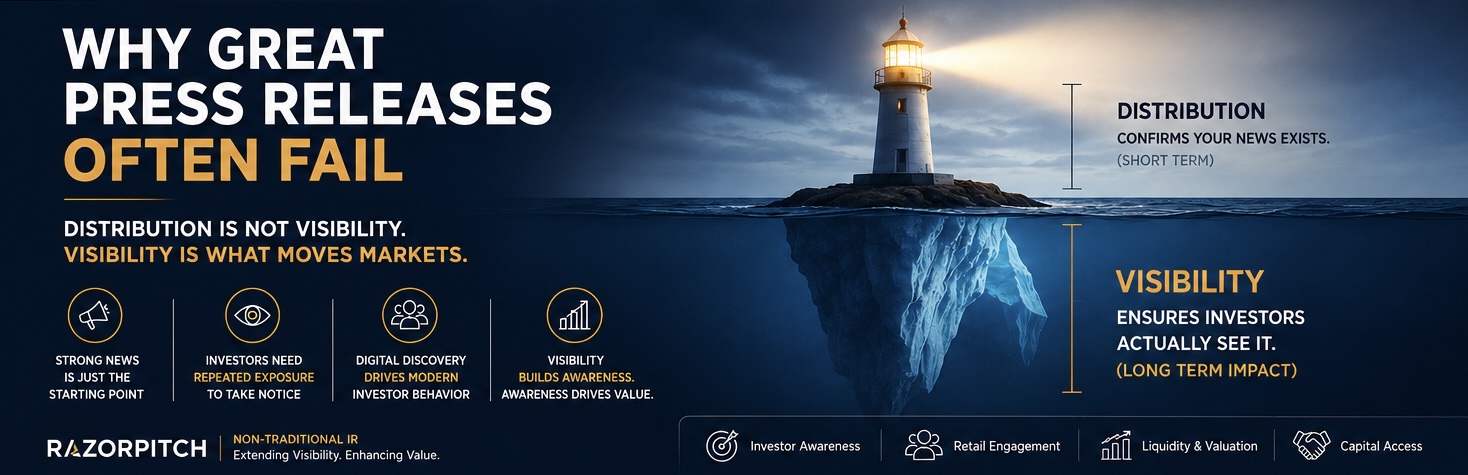
And visibility is not the same thing as distribution.
Distribution Is Not Visibility
Press releases remain foundational to public company communications. They create official disclosure. They establish timelines. They support transparency and regulatory discipline.
Traditional investor relations firms have long played a critical role in helping companies shape these communications responsibly. That expertise is not going anywhere.
But here is what wire distribution actually does: it confirms that information exists.
Visibility is something different. Visibility determines whether investors actually encounter that information, repeatedly, across the channels where they pay attention.
In modern markets, those are not the same thing. And confusing them is expensive.
The market cannot react to what it never sees.
Why Good News Gets Ignored
Public markets now operate inside a nonstop information environment. Every day, investors are flooded with:
- Earnings releases and economic headlines
- Social media commentary and algorithmic feeds
- Analyst notes and market alerts
- AI-generated summaries
- Announcements from every other company competing for the same attention
For small-cap and micro-cap companies, this creates a structural problem. Even genuinely strong announcements can disappear within hours if they are not actively amplified.
It is not that investors saw your news and were unimpressed. In most cases, they simply never encountered it at all.
How Investors Actually Discover Companies Today
This is where the modern investor relations conversation has to evolve.
Investor behavior is increasingly driven by digital discovery patterns that did not exist a decade ago:
- Search behavior and financial content aggregation
- Social sharing and algorithmic feeds
- Retail investing communities and ticker-tagged content
- Mobile-first consumption and newsletter ecosystems
- Sponsored editorial coverage on financial media platforms
Algorithms reward repetition, engagement, and ongoing visibility. A single press release rarely creates enough digital momentum on its own to move through those systems.
Retail participation has also become a much larger force in market activity, particularly in the small-cap environment. These investors are discovering companies through search engines, financial media, and social feeds, not wire services.
If your news is not circulating in those ecosystems, a significant portion of your potential investor audience is simply not seeing it.
Repeated Exposure Is What Actually Builds Awareness
One of the biggest misconceptions in investor communications is that major news automatically creates lasting market awareness.
It does not.
Investors who encounter your company once rarely remember it. Investors who encounter your company consistently begin to recognize it, understand it, and consider it.
That recognition matters enormously during financing windows, liquidity cycles, and market awareness campaigns. Familiarity is not a soft metric. It is a capital formation input.
Consider what a company might announce in a given year:
- New contracts or revenue milestones
- Strategic partnerships or acquisitions
- Technology developments or clinical updates
- Exchange uplisting progress
- Leadership additions or operational milestones
Each of these represents a visibility opportunity. But if investors only encounter each piece of news once, the compounding awareness effect never materializes.
The goal is not to manufacture hype. The goal is sustained discoverability, keeping important developments circulating long enough that the right investors actually find them.
Press Releases Are the Starting Point, Not the Finish Line
Traditional IR builds the foundation. Institutional positioning, analyst engagement, governance communications, disclosure strategy. That work is essential and irreplaceable.
But in modern markets, disclosure alone rarely creates sustained attention. The news cycle moves fast. Attention is fragmented. And the investors who might care most about your story are increasingly discovering companies through digital channels that a wire distribution alone does not reach.
Non-Traditional IR addresses this gap by extending important news into broader digital ecosystems through investor awareness campaigns, content amplification, and consistent market visibility efforts that outlast the initial release window.
That is not a replacement for your IR firm. It is the visibility layer that makes their work compound.
What This Looks Like in Practice
Companies that get investor visibility right are not just announcing and moving on. They are treating each major development as a visibility asset with a longer shelf life than the release date.
That means:
- Translating technical announcements into investor-readable narratives that reach broader audiences
- Distributing content across the financial media platforms and communities where retail investors actually spend time
- Reinforcing recurring corporate themes so investors build familiarity over time, not just awareness of a single event
- Maintaining ticker visibility between major announcements so the market does not forget the story exists
- Using search-optimized content to improve discoverability for investors actively researching the sector
This is increasingly why public companies are exploring IR strategies that combine traditional investor relations with digital-first amplification and ongoing investor visibility initiatives.
The companies gaining visibility today are not necessarily the ones with the best news. They are often the ones doing the best job of making sure the right investors see it.
The Bottom Line
Your press release is not failing because the news is bad.
It is failing because distribution is not the same as visibility, and visibility is not the same as awareness.
In today’s market environment, building genuine investor awareness requires consistent amplification, repeated exposure, and a digital visibility strategy that keeps important developments circulating well beyond the initial wire drop.
That is where Non-Traditional IR begins to add real value alongside the traditional investor relations work your company is already doing.
For public companies evaluating how to extend the reach and lifespan of their investor communications, the conversation around Non-Traditional IR and digital amplification strategy is increasingly relevant. RazorPitch works alongside traditional IR teams to build the visibility layer that makes important news reach the investors it should